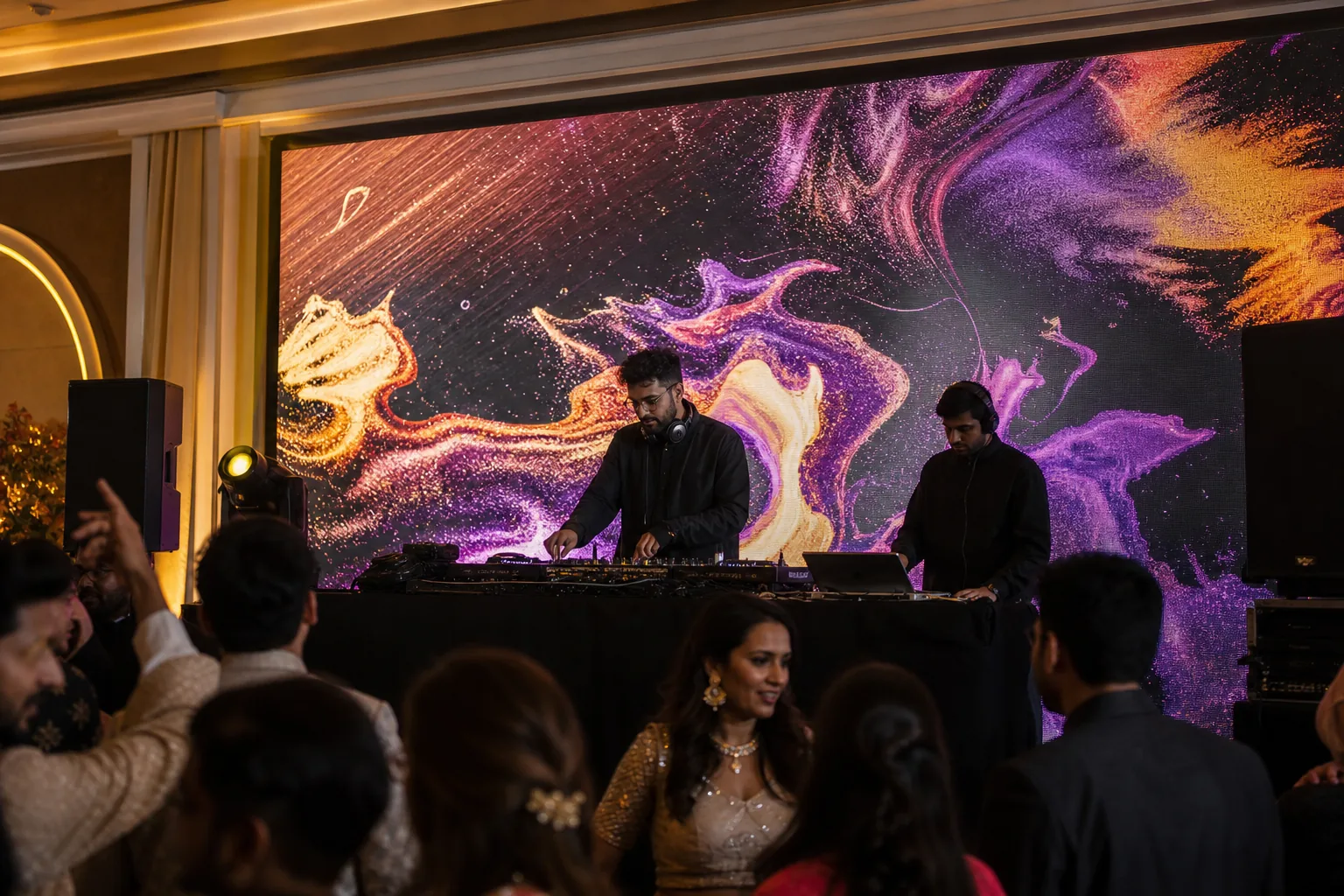
The difference between a DJ and a VJ comes down to what each performs: a DJ shapes the music, while a VJ shapes the pictures guests see. At weddings and corporate events, the roles can also meet in one audio-visual set. Knowing what that means helps you brief the right performance for your room.
DJ, VJ and RJ: what each role does
A DJ, or disc jockey, selects and mixes recorded music for an audience. At a live event, that can mean building the music flow, matching beats between tracks, and changing direction as the crowd responds. A VJ, or video jockey, works with moving images. The term has more than one meaning: it can describe a host who introduces music videos, or a performer who mixes visuals live.
Wikipedia’s definition of a disc jockey covers the role of selecting and presenting recorded music. For your event, the useful question is more specific: who is shaping the sound, and who is responsible for what appears on screen?
A radio jockey, or RJ, presents content for a radio audience. An event host or MC speaks to a live room, introduces people and segments, and helps guide the programme. These roles can overlap in a person’s skills, but they have different jobs. A DJ isn’t automatically an MC, and a VJ isn’t automatically the event host.
In a typical audio-focused set, the DJ works with music and the VJ works with visual content. A hybrid audio-visual DJ brings both into one performance. That can mean the performer chooses a track and triggers a related visual moment as the music changes, rather than leaving a screen to run on its own.
For a sangeet, you might want the DJ to manage entries, family performances and the open dance floor. If the screen also needs to respond to those moments, ask how the visual role will be handled. I plan my wedding performances around the flow of the event, including the music moments that matter to the couple.
Key takeaway: A DJ leads the music, a VJ leads the visuals, and an audio-visual DJ brings both into one coordinated set.
How the VJ role evolved from MTV to live events
VJ first became widely known as a name for a television presenter who introduced music videos. In that setting, the VJ spoke to viewers between clips, much as an RJ introduces songs on radio. MTV helped make the term familiar, though its meaning has changed with the places people watch and perform video.
Wikipedia’s account of the video jockey describes both the television-host meaning and the later use of VJ for performers who work with visuals. At an event today, people may use VJ to mean the person mixing images behind a DJ, rather than someone presenting a programme on camera.
That shift makes it worth clarifying the role before you book. Does the VJ select and mix visuals live, or are they playing a prepared video? Are they working alongside the DJ, or is one performer handling music and pictures? The answer affects rehearsal, cueing and who needs to be present at the venue.
Live event visuals can be abstract shapes, moving patterns, footage or content made for a particular theme. The VJ chooses what to show and when to change it. In a coordinated set, the visual change can follow a musical transition, a drop or a planned reveal. In a separate setup, the DJ and VJ need a clear way to stay in time with each other.
For corporate events, screens may carry presentation content during one part of the programme and performance visuals later. That change needs planning. The event team should confirm who takes control of the display, when the visuals begin, and how the music cue lines up with speeches or stage moments.
How DJs and VJs mix sound and visuals on stage
A DJ works with the audio mix. They choose what plays next, set the transition point, and adjust the pace based on the room. A VJ works with the visual mix, selecting or triggering images as the performance unfolds. In a hybrid set, music and visuals respond to one another instead of running as two unrelated tracks.
For example, at a reception, the couple’s entrance could have a planned music cue and a matching visual change. Later, the DJ might move into a familiar dance track. The visual mix can change with that shift, while the performer still reads the floor and adjusts the music if guests respond differently than expected.
That is the working difference between a DJ set with a screen nearby and a live audio-visual performance. A screen can show a logo or a loop without being part of the mix. In a live visual set, someone is choosing and timing the content as the music moves. My audio-visual DJ sets bring music and custom visuals together for the event, so I am choosing and timing both.
Before the event, the performer and organiser need to agree on the run of show. Mark the moments that need a cue, such as an entry or a product reveal. Then check who will handle the screen when the programme changes. If a speech runs long, the music and visuals may need to wait rather than follow a fixed timeline.
| Role | Main live task | What guests notice | Useful when |
|---|---|---|---|
| DJ | Selects and mixes music | Music flow and changes in energy | The room needs music-led entertainment |
| VJ | Selects or mixes video content | Images changing with the performance | Visual content is a planned part of the event |
| RJ | Presents content for radio | A voice introducing or linking segments | The format is a radio programme |
| Audio-visual DJ | Directs music and visuals as one set | Sound and screen moments landing together | You want a coordinated audio-visual performance |
Gear, video preparation and new VJ workflows
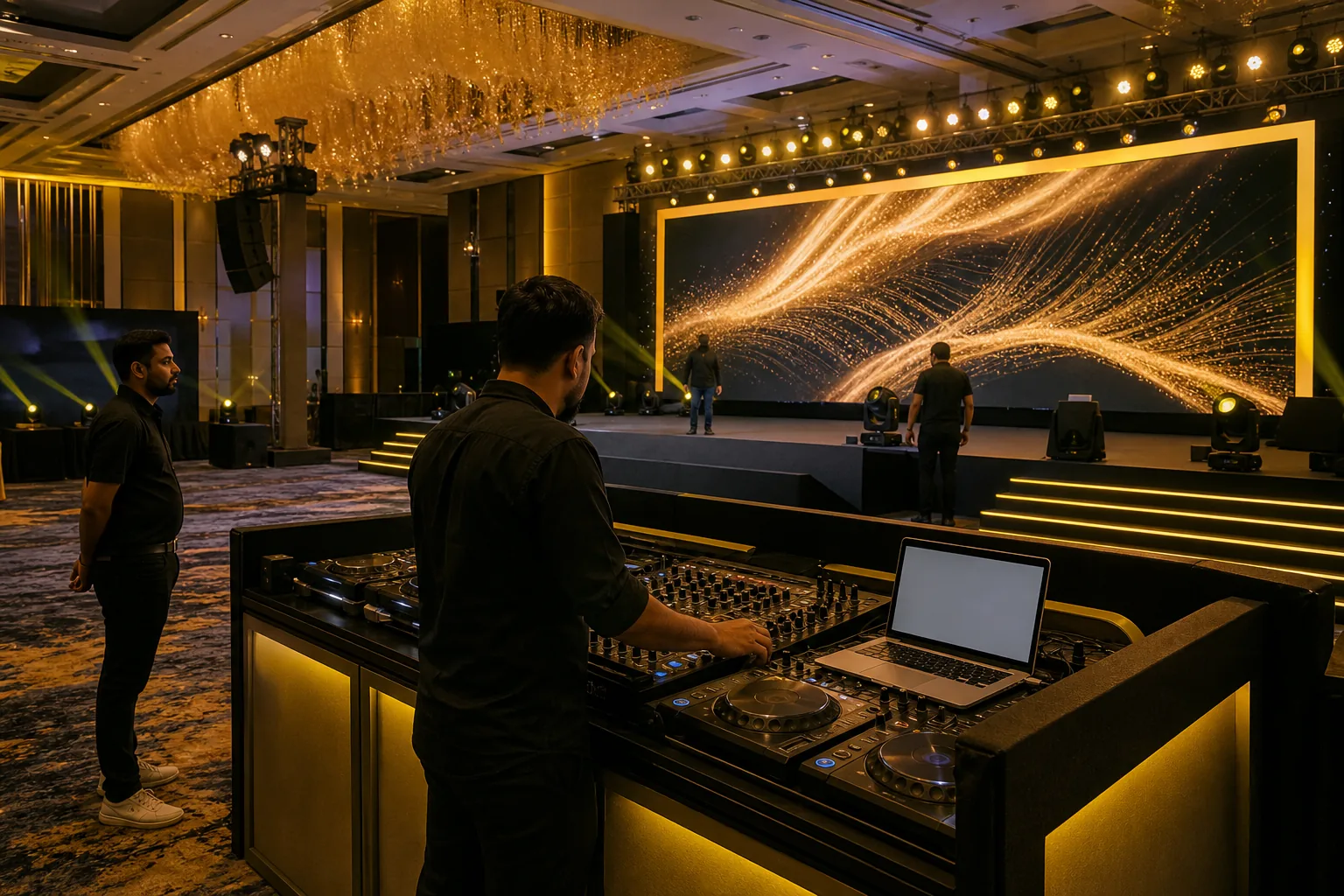
A DJ’s setup centres on playback and audio control. It may include a computer or media players, a mixer or controller, headphones, and a sound system. A VJ needs a way to play and control video, plus a reliable path to the venue’s screen or projector. A hybrid set has to support both jobs without making the booth difficult to run.
The exact equipment depends on the room and the production plan. A large screen, for example, needs a suitable video feed and a clear view from the audience. The organiser should confirm what the venue supplies, what the performer brings, and who checks the connections before guests arrive. Don’t assume that a screen is ready for live content just because it is present in the room.
Visual preparation starts with the event brief. Share the theme, brand or couple’s preferences, plus any key cues. Then agree which parts need custom content and which can use prepared visuals. If you source clips, confirm that they’re cleared for the intended event use. If you make them, check the format with the production team before show day.
There’s a difference between preparing a visual library and scripting every second. A prepared library gives the performer options. A fixed sequence can suit a rehearsed reveal, but it may be less flexible if the programme shifts. Live mixing leaves room to respond to the music and crowd, provided the operator has tested the playback and screen setup.
For an audio-visual performance, budget around the scope rather than the word VJ alone. The event type, set duration, travel, screen needs and custom content can all affect the work involved. Ask for a clear outline of what the performance includes, who supplies the display equipment, and how cues will be managed. My signature sets as DJ VIC combine curated music, original remixes and custom visuals tailored to the event. I also release weekly Bollywood x Disco remixes as VIC.
Pro tip: Ask for a short technical check before doors open. Confirm the screen feed, cue points and handover plan with the venue team.
Venues, audience expectations and choosing the right live setup
The right setup depends on what guests should experience. At a sangeet, the music may need to support family performances before it opens into a dance set. At a corporate celebration, the DJ may need to pause for awards or speeches, then bring the room back to the floor. Visuals can add to those moments, but only if the screen has a clear purpose.
For a product launch, a planned visual cue can help mark a reveal. For a wedding reception, a visual may support an entrance or a change in the evening’s mood. In both cases, the organiser should share the timeline early. The performer can then plan around stage cues instead of guessing when the next segment will begin.
Audience expectations also change with the room. Guests may watch a screen during a reveal, then focus on the dance floor once the music builds. A VJ or audio-visual DJ should know when visuals need attention and when they should support the music quietly. The goal is to make the screen part of the event, not a distraction from it.
Before you decide, ask a few direct questions:
- Who will mix the visuals, and who controls the screen during speeches?
- Are the visuals prepared for the event, or selected live from a library?
- What equipment must the venue provide, and when will it be tested?
- How will the performer handle a change in timing or a late cue?
- Can the music plan include must-plays and moments the client wants to avoid?
I am based in Bangalore (Bengaluru) and perform across India and internationally. Since 2007 I have played more than 1,400 nights in 18 countries. For a wedding or corporate event, start with the date, city, duration and room setup when you check my availability. Pricing depends on the event scope and setup.
Frequently asked questions
What is the main difference between a DJ and a VJ?
A DJ works mainly with music, while a VJ works mainly with moving images. A DJ selects and mixes tracks for the room. A VJ selects or mixes visuals for a screen. At some events, one performer handles both roles as an audio-visual DJ, so the visuals can respond to the music in the same set.
Can one person be both a DJ and a VJ?
Yes, one performer can handle both music and visuals if the set and equipment support that work. This is often called an audio-visual DJ set. Ask how the performer will manage both tasks live, what the venue needs to provide, and whether the visuals are custom-made or selected during the event.
Does a VJ perform live or play pre-made videos?
A VJ may mix visuals live, use prepared clips, or combine both approaches. The word VJ can refer to different roles, so confirm what it means for your booking. Ask whether visuals will change with the music and who will manage them if the event schedule shifts.
Do weddings need a VJ as well as a DJ?
No, a separate VJ isn’t needed for every wedding. If you want screen content to match entrances, performances or music cues, include visual production in the plan. A DJ-led audio-visual set can combine those parts. If music is the main focus, a DJ may be enough for your event.
What should I ask before booking an audio-visual DJ?
Ask what the set includes, who supplies the screen or projector, and how custom visuals are prepared. Confirm the timing for key moments and who coordinates cues with the planner or venue. Share your event date, location, duration and setup needs so the performer can assess the fit and provide an enquiry-based quote.
Choose the setup that fits the room
If music and screen moments need to work as one, ask for an audio-visual set and confirm the venue requirements before booking. Share your date, city and event plan with me through the booking enquiry page. You can also write to bookings@djvicofficial.com | +91 96117 11677.